
ZIP Screen Buying Guide 2026
The only exterior screen that stays put at 75 mph. Here's how the zipper mechanism works, which fabric to pick, and what it costs.
Updated June 2026 · 14 min read
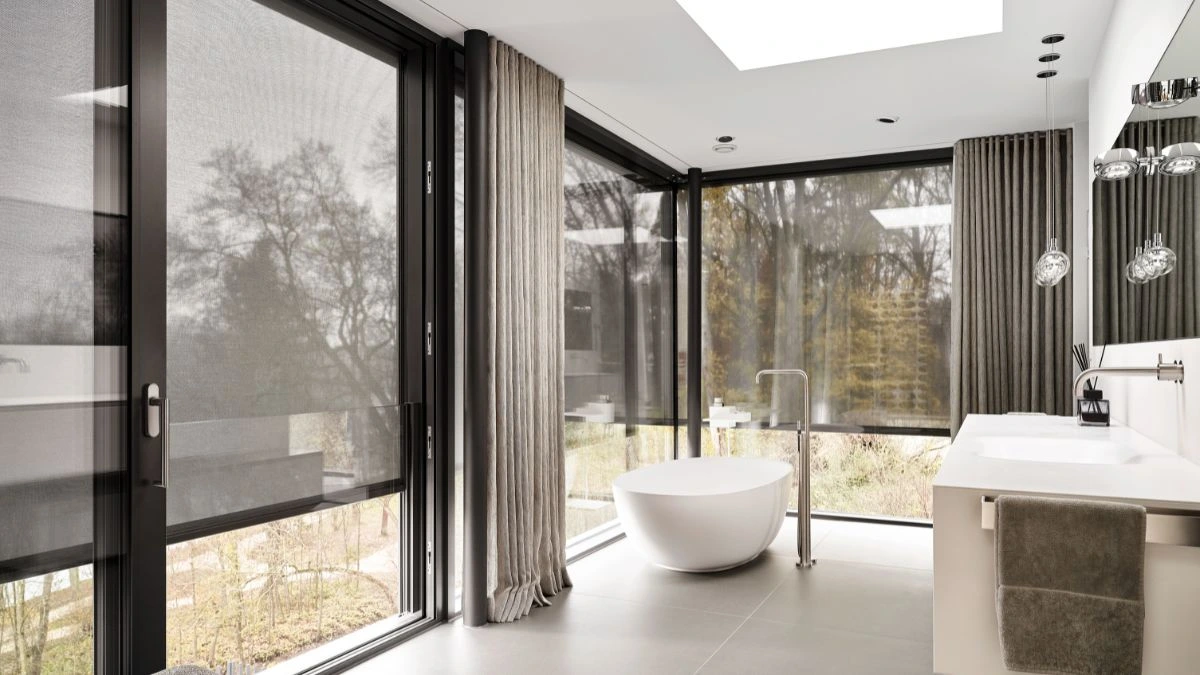
Standard roller screens billow in the wind, clatter against the frame, and eventually tear. A ZIP screen solves this with a deceptively simple mechanism: the fabric edge is threaded with a flexible bead that locks into a slot running the full height of each guide rail — like a zipper. Under wind load the fabric pulls tighter into the slot rather than lifting out of it.
The result is an exterior screen rated for winds up to 75 mph (120 km/h) that blocks 75–93 % of solar heat gain while leaving your view virtually intact. Unlike exterior roller shutters (Rollladen) that close the window completely, a 5 % openness-factor ZIP screen blocks the heat but lets you watch the sunset.
This guide covers how to choose the right fabric, what frame system fits your wall, which motor to specify, and real US pricing — so you can compare quotes confidently.
How the ZIP mechanism works
A flexible PVC or nylon bead is bonded to both side edges of the fabric roll during manufacturing. It runs the full drop height.
Two extruded aluminum rails are fixed to the wall, one on each side. Each rail has a narrow slot just wide enough for the bead — too narrow for the fabric itself.
When wind pushes the fabric outward, the bead is pulled against the slot's inner edge. Wind pressure locks the fabric tighter — the opposite of a standard screen that pulls free.
Because the fabric is under constant lateral tension from the rails, there is no flutter or rattle. Motorized retraction takes 25–45 seconds depending on drop height.
Meister-Tipp
ZIP screen vs exterior roller shutters vs standard screen
| Feature | ZIP Screen | Exterior Roller Shutters | Standard Screen |
|---|---|---|---|
| View preserved | ✅ Yes (5–10 % OF) | ❌ Closed when down | ✅ Yes |
| Solar block | 75–93 % | 95–99 % | 40–65 % |
| Wind resistance | 75 mph (zipper) | 55–70 mph | 25–35 mph |
| Blackout capable | ✅ 0 % fabric | ✅ Full blackout | ❌ No |
| Burglar deterrent | ❌ No | ✅ Strong | ❌ No |
| Terrace / pergola use | ✅ Wide spans available | ❌ Window-width only | ⚠️ Limited |
| Noise reduction | ⚠️ Moderate | ✅ Significant | ❌ Minimal |
| Cost per window | $900–$2,500 | $1,200–$2,800 | $300–$900 |
| Storm (hurricane) rated | ❌ No | ❌ (standard) | ❌ No |
ℹ️ZIP screen vs roller shutter — when each wins
Choosing the right fabric: openness factor (OF)
Openness factor describes the percentage of the fabric surface that is open mesh — i.e., not blocked by fiber or coating. A 5 % OF fabric has 5 % open area; the remaining 95 % is coated fiberglass or HDPE that blocks or reflects solar radiation.
| Openness Factor | Label | Solar Block | Visibility | Best For |
|---|---|---|---|---|
| 0 % | Blackout | 95 % | None | Media rooms, shift workers, complete darkness needed |
| 1–3 % | Privacy Screen | 92–95 % | One-way daytime | Street-facing rooms, offices, ground floor |
| 5 % | Standard View | 87–90 % | Clear (tinted) | Living rooms, most residential windows |
| 10 % | Open View | 78–82 % | Crystal clear | Terraces, panoramic windows, mountain/water views |
* Solar block values assume standard white/beige fiberglass fabric at 45° sun angle. Dark-colored fabrics block slightly more radiation but re-radiate more heat — specify light colors (white, silver, pearl) for maximum thermal benefit.
Meister-Tipp
Frame and box systems
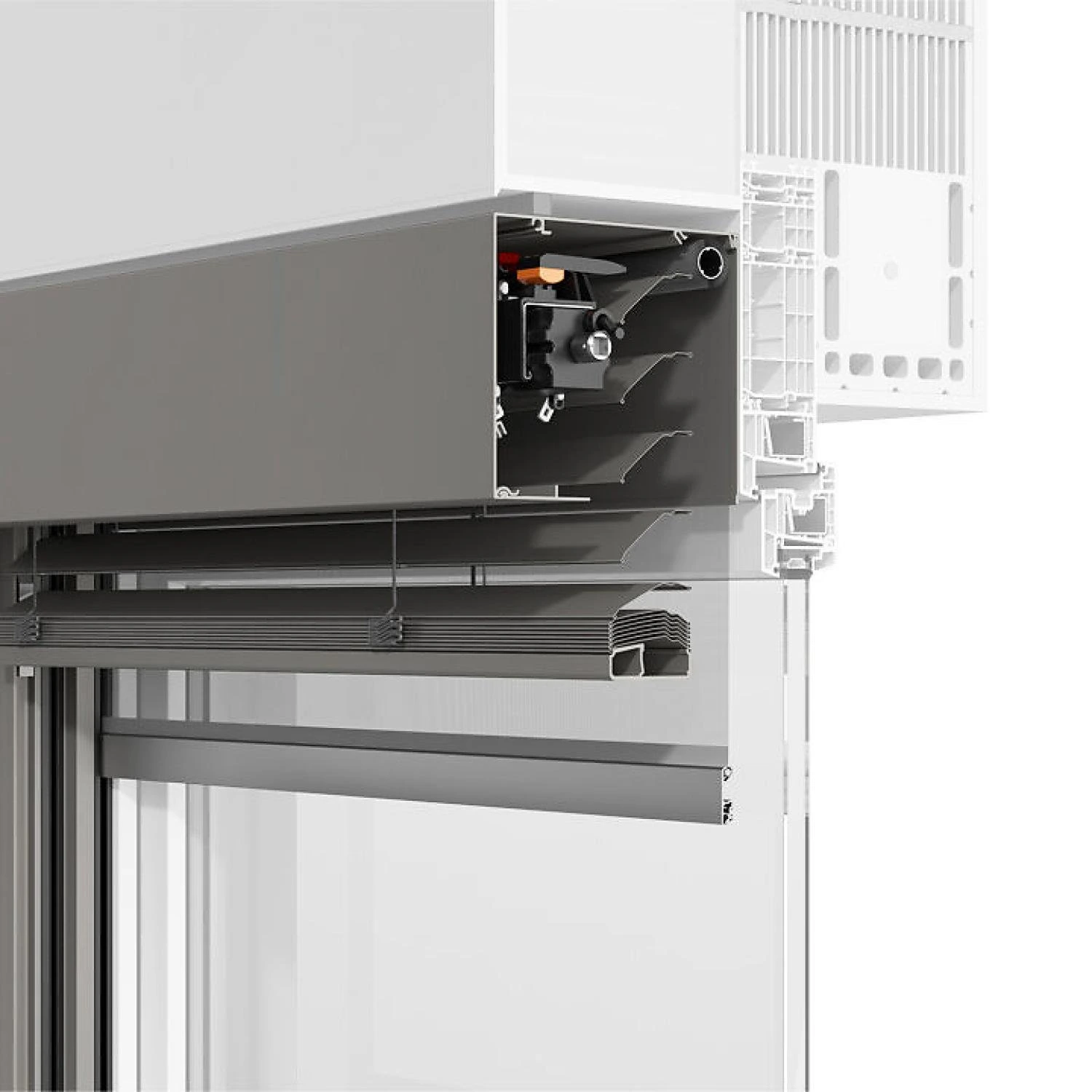
Box sits proud of the wall. No cutting required. Guide rails surface-mount to window surround. Installed in 3–5 hours per window.
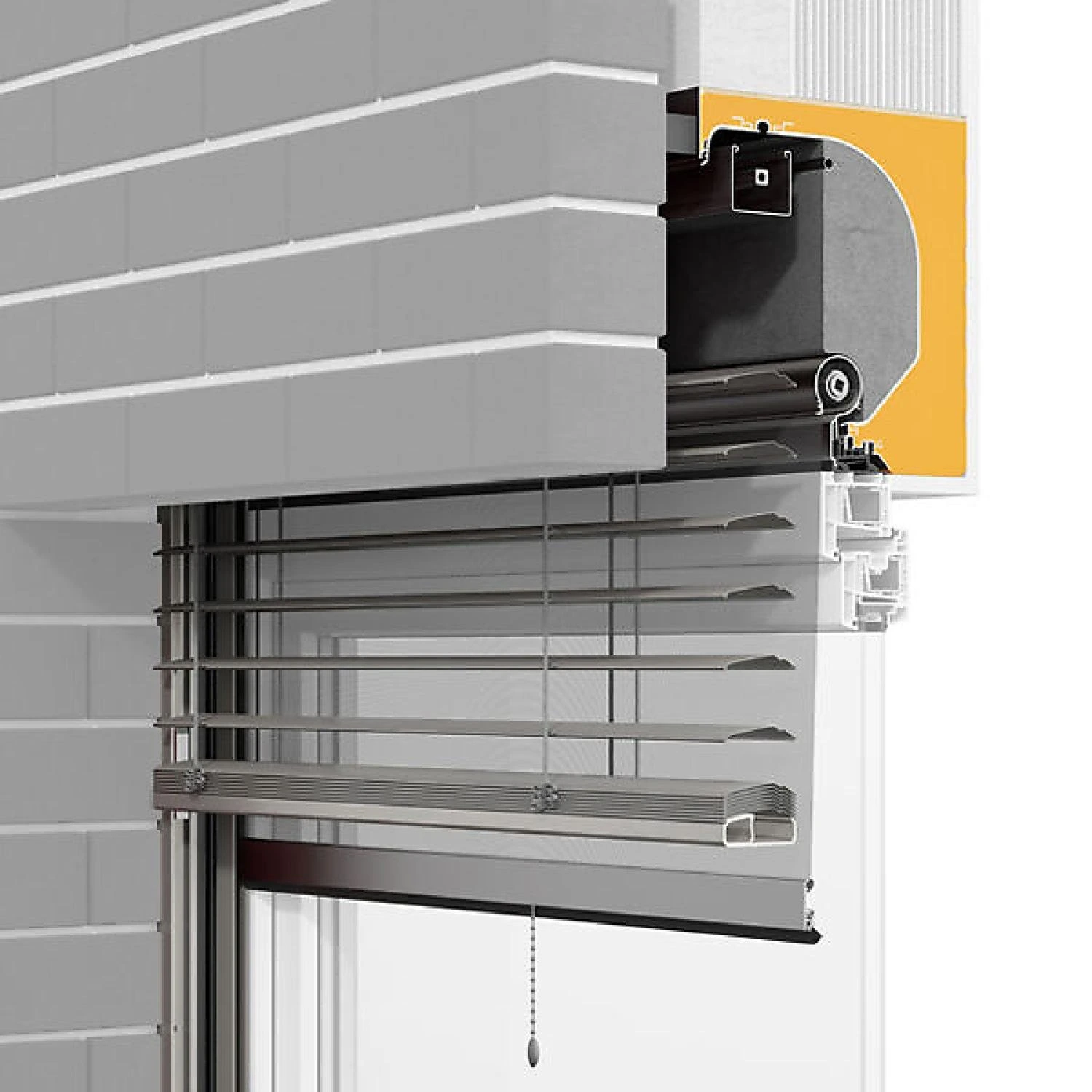
Box is concealed in a pocket above the window. Requires coordination with framing/masonry. Flush facade appearance — most European standard.
Available in spans up to 196 in wide × 196 in drop. Two or more units can be linked for wider coverage. Post-and-beam or wall-and-post configurations.
Motor options and smart home integration
- ✅ Unlimited cycle life (no battery concern)
- ✅ 5-year manufacturer warranty
- ✅ io-homecontrol = position feedback + smart home
- ✅ Somfy TaHoma hub: HomeKit, Alexa, Google
- ⚠️ Requires 120V outlet behind wall or in box
- ⚠️ Electrician required: $150–$300 per run
- ✅ Zero wiring — no electrician needed
- ✅ Panel charges from daylight (not direct sun only)
- ✅ 30–45 day battery reserve
- ✅ Wireless: Somfy RTS remote or app
- ⚠️ RTS = one-way (no position confirmation)
- ⚠️ Shade behind panels reduces charge rate
💡io-homecontrol vs RTS — always choose io if budget allows
Smart home setup — step by step
Install Somfy TaHoma switch hub → connect to Wi-Fi → add hub in Apple Home app via HomeKit code → screens appear as "Window Covering" accessories. Automate with Home scenes (e.g. "When temperature > 80°F, close to 80%").
Enable the Somfy TaHoma skill in the Alexa app → sign in with your TaHoma account → Alexa discovers all io/RTS devices. Voice commands: "Alexa, lower the living room screen to 50 %."
Link TaHoma via Google Home "Works with Google" → screens appear under Blinds & Shades. Use Google Assistant routines to schedule position based on time or sunrise/sunset.
Automation scenarios
Sun tracker lowers screen to 80 % when sun hits the glass between 10 am–4 pm. Raises automatically at sunset. Cuts AC runtime 25–40 %.
Anemometer (included or add-on) triggers full retraction at 35–40 mph. Prevents damage before you even notice the wind picking up.
Lower to 30 % at sunrise — soft morning light enters while blocking early low-angle sun glare. Raises fully after 9 am.
When leaving home, all ZIP screens lower to 80 %. Keeps interior cool without total blackout. Reduces cooling load on unoccupied days.
Wind performance and storm limits
| Wind Speed | Beaufort | ZIP Screen Status |
|---|---|---|
| Up to 25 mph | Force 5 | ✅ Normal operation |
| 25–35 mph | Force 6–7 | ✅ Operates; some vibration at wide spans |
| 35–45 mph | Force 7–8 | ⚠️ Auto-retract threshold (anemometer triggers) |
| 45–75 mph | Force 9–12 | ✅ Retracted — fabric secured in box |
| 75–120 mph+ | Hurricane | ❌ Box and rail must be impact-rated; fabric retracted |
⚠️ZIP screens are not hurricane-rated
ZIP screen cost guide 2026
Prices below cover supply and installation in the continental US. Solar motor is included; io-homecontrol upgrade adds $80–$120/unit. Large terrace systems may require a structural assessment.
| Application | Max Width × Drop | Supply Only | Installed |
|---|---|---|---|
| Small window | 60 in × 84 in | $600–$900 | $900–$1,400 |
| Standard window | 84 in × 96 in | $800–$1,300 | $1,200–$1,900 |
| Patio / French door | 96 in × 108 in | $1,000–$1,700 | $1,400–$2,400 |
| Wide patio door | 120 in × 108 in | $1,400–$2,200 | $1,900–$3,000 |
| Terrace span (single) | 160 in × 140 in | $2,200–$3,500 | $3,000–$5,000 |
| Terrace span (linked ×2) | 196 in × 196 in | $4,000–$6,500 | $5,500–$9,000 |
Prices reflect mid-range fiberglass fabric with solar motor, surface-mount box, standard white powder-coat finish. Custom colors, io-homecontrol upgrade, or structural pergola bases increase cost. West Coast and Northeast labor markets may add 15–25 %.
What drives the price
When to choose a ZIP screen
The most popular use case. A ZIP screen converts a pergola into a shaded outdoor room while keeping air flow and the view. Wind-resistance means it handles afternoon thunderstorms without retraction.
A 3–5 % OF screen eliminates monitor glare completely while maintaining daylight. Unlike external venetian blinds, it needs no angle adjustment throughout the day.
Large glass facades gain enormous solar heat. A single ZIP screen covering a 10 ft × 12 ft glass wall blocks the equivalent of 2–3 tons of unwanted cooling load.
External venetian blinds or roller shutters mean losing the view. A 10 % OF ZIP screen blocks 78 % of solar heat while the glass facade looks virtually clear from inside.
Where standard awnings and screens fail at 20–25 mph, ZIP screens operate to 75 mph — making them practical in exposed locations where other solar control products are useless.
Passivhaus design uses exterior shading to avoid peak summer cooling loads. ZIP screens on south and west glazing are the simplest retrofit to approach Passivhaus solar discipline.
Specification checklist before requesting quotes
- ☑Measure each opening: width × drop height (to nearest ¼ inch)
- ☑Note wall material at mounting points: wood frame, masonry, stucco, EIFS
- ☑Decide box type: surface-mount (retrofit) or integrated (new build)
- ☑Choose openness factor: order physical samples before deciding
- ☑Choose fabric color: light colors (white, pearl, grey) outperform dark in solar blocking
- ☑Motor protocol: RTS (budget) or io-homecontrol (smart home / position feedback)
- ☑Power source: solar motor (no wiring) vs hardwired 120V (unlimited cycles)
- ☑Add wind sensor: anemometer auto-retract included or optional per model
- ☑Smart hub: Somfy TaHoma switch if using HomeKit / Alexa / Google
- ☑Get 3 quotes: specify same fabric OF, box type, and motor protocol for apples-to-apples
Maintenance, lifespan & warranty
Rinse with a garden hose 1–2× per year. For stubborn dirt, use a mild pH-neutral soap and a soft brush — no pressure washers, no solvents. The PVC or fiberglass coating degrades under harsh chemicals.
Apply a thin layer of PTFE (Teflon) dry lubricant to the guide rail slots every 2–3 years. Do not use oil-based lubricants — they attract dust that causes the zipper bead to bind.
Once a year: check that the box lid seals correctly, verify motor limit positions still match full open/closed, and confirm the anemometer cable connection is intact.
| Component | Expected Lifespan | Replacement Cost | Warranty (ROMA) |
|---|---|---|---|
| Fabric | 10–15 years (UV exposure) | $150–$400 fabric only | 2 years |
| Tubular motor (hardwired) | 15–25 years / ~50,000 cycles | $120–$280 motor + labor | 5 years (Somfy) |
| Solar motor + battery | 10–15 years (battery) | $150–$350 motor + labor | 5 years (Somfy) |
| Aluminum guide rails | 30–50 years | Rarely replaced | 10 years |
| Box / housing | 20–40 years | Rarely replaced | 5 years |

ZIP screens from Meylen — the ROMA specialist
Meylen imports ROMA ZIP screen systems directly from Germany and supplies installers across the US. Contact them for a quote with correct rail profiles, fabric specs, and motor pairing for your project.
Get a ZIP screen quote at meylen.com →Frequently asked questions
What is a ZIP screen?
A ZIP screen is a motorized exterior fabric screen where the fabric edge is locked into aluminum guide rails via a zipper-bead system. Unlike standard roller screens, the zipped edge prevents billowing in wind — allowing operation at wind speeds up to 75 mph (120 km/h). ZIP screens block 75–93% of solar heat while preserving the view.
How much does a ZIP screen cost?
ZIP screen costs in the US range from $900–$1,500 for a small window (up to 60"×84"), $1,400–$2,500 for a standard window or patio door (up to 96"×108"), and $2,500–$5,000+ for large terrace spans. Pricing includes motorization; installation adds $200–$500 per unit.
What openness factor (OF) should I choose?
5% openness factor is the most popular choice: you retain a clear, slightly tinted view from inside while blocking 87–90% of solar heat. For terraces where you want maximum view preservation, choose 10% OF. For complete privacy or home theaters, choose 1–3% OF. Blackout (0%) is typically used only for media rooms.
Can a ZIP screen withstand Florida or Gulf Coast storms?
ZIP screens are wind-resistant up to 75 mph (120 km/h) with auto-retract at 35–45 mph — making them suitable for typical afternoon thunderstorms. They do NOT meet Florida HVHZ (Miami-Dade NOA) hurricane-code requirements. For full storm protection in hurricane zones, combine ZIP screens with accordion or roll-down storm shutters.
Do ZIP screens work without electricity?
Yes — solar-powered ZIP screens are available with a panel-and-battery motor that charges from daylight and holds a 30–45 day charge reserve. No wall outlet, no conduit, no electrician needed. The motor communicates wirelessly (Somfy RTS or io-homecontrol) and can be integrated with HomeKit, Alexa, or Google Home via a smart hub.