
Exterior Roller Shutters vs Hurricane Shutters:
Which is Right for Your Home?
Florida accordion shutters and German Rollladen both roll down to protect your windows. But one works 365 days a year and the other sits folded until the next storm warning. Here is the honest comparison — including where each is legally required, what insurance savings look like, and who should choose what.
Hurricane Shutters
Emergency protection deployed before storms. FBC/Miami-Dade code-certified. Qualifies for Florida insurance discounts. Zero daily utility — folded, bolted, or stacked 11 months a year.
Rollladen
Daily-use exterior shutters: block 90% of solar heat, provide full blackout, add security, and reduce heating costs. ALUMINO protect profiles also deflect storm debris. Not FBC/NOA-certified for HVHZ zones.
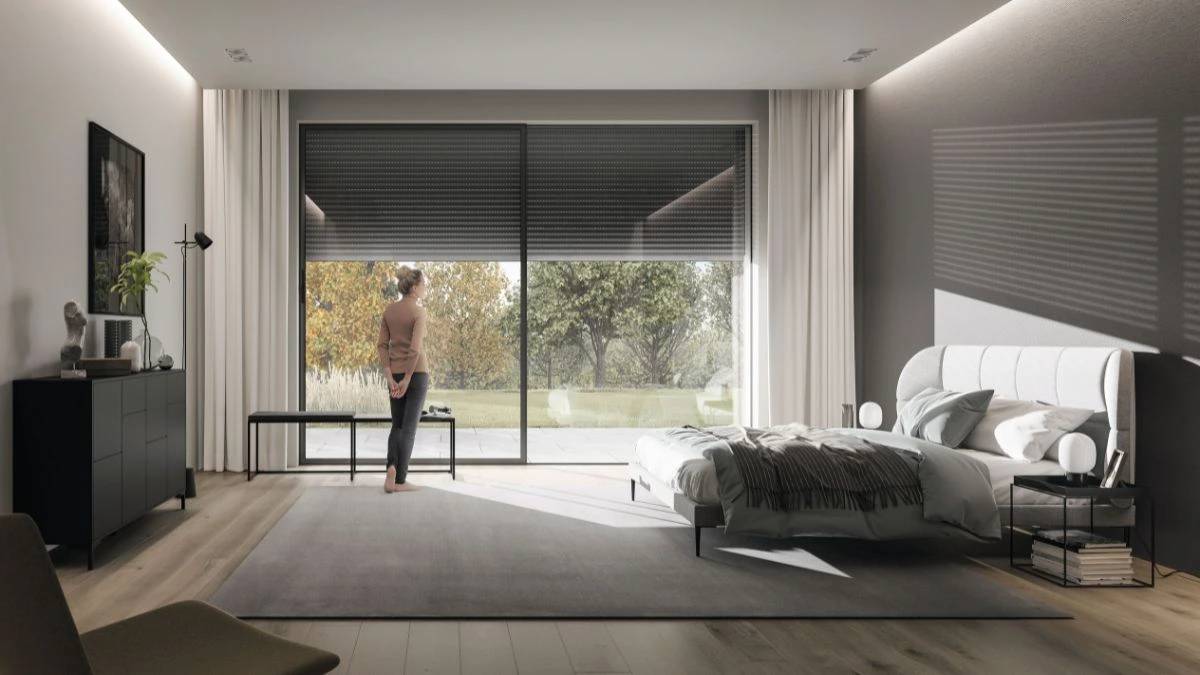
ROMA Rollladen with ALUMINO protect profiles — foam-filled aluminum for storm deflection and daily use. © ROMA / meylen.com
🌀 Hurricane Shutter Types — and What They Cost
The US hurricane shutter market is dominated by four product types. Each handles storms differently — and none of them do anything for you on a Tuesday in July.
📋 1. Storm Panels
CheapestCorrugated aluminum or steel sheets that bolt or track over windows before a storm. Must be stored somewhere (garage, shed) and manually installed before every hurricane — a 2–4 hour job for a full house.
🪗 2. Accordion Shutters
Most commonHinged aluminum slat panels mounted permanently beside windows. Fold flat to the side during fair weather; pulled across and latched before storms. No storage needed, fast deployment — the most popular Florida retrofit.
⬇️ 3. Roll-Down (motorized)
Most similar to RollladenMotorized aluminum slat curtains in a box above the window — visually similar to a Rollladen. Designed and tested for hurricane deployment, not daily use. Most homeowners leave them open and only lower them for storms.
🪢 4. Fabric / Screen Shutters
Budget motorizedWoven fiberglass or polyester screens on tracks that roll down over openings. Lighter-duty protection, tested for wind but less debris-resistant. Provides partial sun screening daily — the closest American equivalent to a ZIP screen.
🛡️ What a Rollladen Actually Does in a Storm
ROMA Rollladen are not designed and tested as hurricane shutters. But that does not mean they offer no storm protection — it means that protection is a secondary benefit of a system built for daily use.
ROMA ALUMINO protect slat profile — reinforced aluminum with hard foam fill for maximum debris resistance. © ROMA / meylen.com
A closed Rollladen distributes positive and negative wind pressure across the shutter face rather than the window glass. This significantly reduces the risk of glass failure in moderate storm events (Cat 1–2).
Foam-filled ALUMINO profiles absorb and deflect airborne debris. A closed Rollladen stops branches, gravel, and small projectiles from reaching the glass — preventing depressurization if glass fails.
Guide rails create a tight seal around the window opening. Combined with a closed Rollladen, wind-driven rain infiltration past the window frame is dramatically reduced.
⚠️HVHZ zones: Rollladen are not a code substitute
📍 Where Code Compliance Matters — and Where It Doesn't
The strictest requirements apply to a small geographic area. Most of the US storm belt has no requirement for NOA-certified products on existing homes.
| Region | Code requirement | Rollladen viable? | Recommended approach |
|---|---|---|---|
| Miami-Dade & Broward (HVHZ) | Miami-Dade NOA required — 175 mph, large-missile tested | ⚠️ Complement only | Use code-compliant accordion or roll-down + add Rollladen for daily use on same windows if budget allows |
| Rest of Florida (Palm Beach, Sarasota, Tampa, Jacksonville) | Florida Product Approval required for new construction; retrofits vary by county | ✅ Yes | Rollladen ALUMINO protect as primary protection; confirm with local building dept. |
| Texas Gulf Coast (Houston, Corpus Christi, Galveston) | Wind zone compliance by county; no universal NOA mandate | ✅ Yes | ALUMINO protect for storm + daily cooling — significant AC savings in Texas heat |
| Carolinas / Georgia Coast | IRC wind zone requirements; no NOA mandate outside HVHZ | ✅ Yes | Rollladen for full-year utility; storm protection is secondary benefit |
| All other US (non-coastal) | No hurricane shutter requirements | ✅ Yes | Standard ALUMINO profiles — daily cooling and blackout benefits dominate |
Always check with your local building department
📊 Full Comparison: All Systems Side by Side
| Feature | Storm Panels | Accordion Shutters | Roll-Down (motorized) | Rollladen ALUMINO protect |
|---|---|---|---|---|
| Cost / sq ft | $10–$20 | $15–$30 | $25–$60 | $30–$80 |
| Cost / window | $115–$240 | $400–$600 | $800–$2,500 | $1,000–$2,500 |
| Whole house | $1,500–$4,000 | $3,000–$8,000 | $6,000–$16,000 | $8,000–$25,000 |
| Daily use | None | Minimal (can fold partially) | Possible but rarely used | Every day — blackout, insulation, cooling, security |
| Storm deployment | Bolt on manually, 2–4 hrs per storm | Pull across and lock, 5 min/window | Button press, 30 sec/window | Button press or automatic, 30 sec/window |
| Storage | Garage/shed required | Fold to side of window | Box above window | Integrated box, invisible when open |
| FBC / Miami-Dade NOA | ✓ Approved | ✓ Approved | ✓ Approved | ✗ Not HVHZ-rated |
Hurricane shutter costs based on 2026 US market data. Rollladen costs via meylen.com, fully installed including solar motor and Vorbaukasten.
📅 The Decisive Factor: 365 Days vs 3 Days
The single most important difference between Rollladen and hurricane shutters is how often they do anything useful.
Hurricane shutters: ~3 days/year
- 🌀 Deployed when a named storm approaches — approximately 3 times per decade in an average Florida location
- 📋 Storm panels: stored in garage all year, manually installed for each storm, removed and re-stored after
- 🪗 Accordion shutters: permanently hardware on your facade, deployed for storm days and folded back
- ⬇️ Roll-down motorized: box sits above window; lowered for storm windows, raised immediately after
- RESULT: $3,000–$12,000 investment used approximately 3–15 days over its lifetime
Rollladen: every single day
- 🌅 Morning: lower bedroom shutters 15 minutes before the sun hits the east wall — block heat before it enters
- 💤 Sleep: complete blackout, even at 5:30 AM in summer — no light bleed, no noise from traffic
- 🔒 Away from home: Rollladen closed = burglars cannot see whether anyone is home
- ❄️ Winter nights: closed shutter creates insulating air cushion — window U-value improves ~20%
- 🌀 Storm warning: already installed, lower and lock. Takes 30 seconds per window.
- RESULT: $800–$2,500/window investment used 365 days per year across its 30–50 year lifespan
The math: A motorized roll-down hurricane shutter at $1,200/window installed might be used 15 days over a 10-year period — roughly $80/day of actual use. A Rollladen at $1,500/window installed is used 3,650 days over the same 10 years — roughly $0.41/day of actual use. The storm protection is a free bonus on top.
🛡️ Florida Insurance Discounts: What You Can and Cannot Claim
| Product | Qualifies for FL discount? | Requirements |
|---|---|---|
| Storm panels (aluminum/steel) | ✅ Yes | Valid Florida Product Approval, all openings covered, wind mitigation inspection |
| Accordion shutters | ✅ Yes | Florida Product Approval / Miami-Dade NOA, all openings, inspection |
| Roll-down motorized shutters | ✅ Yes | Florida Product Approval / Miami-Dade NOA, all openings, inspection |
| Fabric/screen hurricane shutters | ✅ Yes (approved types) | Must have Florida Product Approval, all openings, inspection |
| Impact-rated windows (replacement) | ✅ Yes | Replaces shutter need — windows must be Miami-Dade NOA or equivalent |
| Rollladen (ROMA) | ⚠️ Not currently | ROMA does not hold Florida Product Approval or Miami-Dade NOA for insurance purposes |
ℹ️The combined strategy: get the discount AND the daily comfort
🎯 Decision Guide: Who Should Choose What
Code-compliant accordion or roll-down shutters are legally required. Once those are installed, add Rollladen to windows where daily blackout and cooling matter most (bedrooms, south-facing rooms). You get the insurance discount AND the comfort.
Florida windstorm insurance premiums are punishing. If saving 20–30% on your windstorm premium matters, get accordion shutters on all openings for the discount. Then add Rollladen to bedrooms and living areas for daily quality of life.
No NOA requirements. ALUMINO protect profiles provide meaningful debris and wind protection, plus you get daily cooling in the brutal Texas/Southeast summer heat. The AC savings alone often justify the cost in 8–12 years.
Storm protection is not your primary concern. Rollladen deliver blackout for bedroom sleep quality, 25–40% AC savings in summer, security, and a 20% insulation improvement in winter. The ROI is built on energy savings and daily use, not storm protection.
🛒 How to Buy: Getting Quotes You Can Compare
The US market for German-style exterior roller shutters is small but growing. Most installers work through European system suppliers. Here is how to get from decision to installation without overpaying.
Write down: (a) which windows you want covered and approximate dimensions, (b) your wall material (wood frame, brick, stucco, vinyl siding), (c) whether you want solar motor or hardwired, (d) smart home system if any. With this list you can compare quotes on the same spec.
In the US, ROMA products are available through meylen.com. For hurricane shutters, contact at least two Florida-licensed shutter contractors. Specify the same product type and motor brand in each quote — comparing "roll-down shutters" without specifying brand or profile grade produces useless numbers.
Ask: "Which motor protocol do you use — RTS or io-homecontrol?" (io is better), "What fastener pattern do you use on masonry?" (should be 6" on center minimum), "Do you program the motor limits on-site?" (yes, always), "What is your warranty on labor?" (1–2 years is standard).
A complete quote covers: product supply, box and guide rail, all hardware and fasteners, motor and remote(s), programming and commissioning, travel/labor, and disposal of packaging. Beware quotes that separate "product" from "installation" — the total is what matters.
Get Exterior Roller Shutters for Your US Home: meylen.com
Meylen is the authorized ROMA partner for North America. They advise on the right system for your climate zone, handle customs and shipping from Germany, and support local installation — or fly in their own crews for a guaranteed result.
Frequently Asked Questions
Are Rollladen hurricane shutters?↓
Not in the code-compliance sense. In Miami-Dade and Broward counties (Florida's HVHZ), all glazing protection must carry a Miami-Dade NOA (Notice of Acceptance) tested at 175 mph with large-missile impact resistance. ROMA Rollladen are not tested to this standard and cannot substitute for FBC-certified hurricane shutters in HVHZ zones. Outside HVHZ — across most of Florida, Texas, the Carolinas, and the Gulf Coast — Rollladen ALUMINO protect provides meaningful debris and wind protection, and no code-compliance testing is required for the same product performance.
Do hurricane shutters lower homeowners insurance in Florida?↓
Yes — typically 10–30% on the windstorm premium. To qualify, you need an approved shutter type (accordion, roll-down, or storm panels with valid Florida Product Approval or Miami-Dade NOA) covering every single opening including the garage door. A licensed wind mitigation inspector must certify the installation. Missing even one opening disqualifies you from the full discount.
What is the cheapest hurricane shutter option?↓
Storm panels (corrugated aluminum or steel) are the lowest-cost option at $10–$20 per sq ft installed, roughly $115–$240 per standard window. For a 10-window house, total cost runs $1,500–$3,500. The catch: panels must be stored somewhere (garage or shed) and manually bolted over every window before each storm — a 2–4 hour job. They offer zero daily utility.
How do roll-down hurricane shutters compare to Rollladen?↓
They are more similar than most people realize. Both roll into a box above the window and deploy vertically. The key differences: roll-down hurricane shutters are tested to FBC/Miami-Dade impact and wind standards; Rollladen are not. Rollladen however provide insulation, 100% blackout, and daily utility that roll-down hurricane shutters (designed purely for storm deployment) do not. Cost is comparable: motorized roll-down shutters run $25–$60/sq ft, Rollladen $800–$2,000 per window all-in.
Can I use Rollladen as my only storm protection?↓
In non-HVHZ areas (most of the US storm belt outside Miami-Dade and Broward counties), aluminum Rollladen ALUMINO protect with foam-filled profiles provide serious debris deflection and wind-load reduction — many homeowners use them as their primary storm protection. In Miami-Dade and Broward HVHZ, you must use FBC-NOA certified products. Everywhere else, Rollladen protect your glass, reduce wind pressure on openings, and work every single day of the year — which standard hurricane shutters do not.